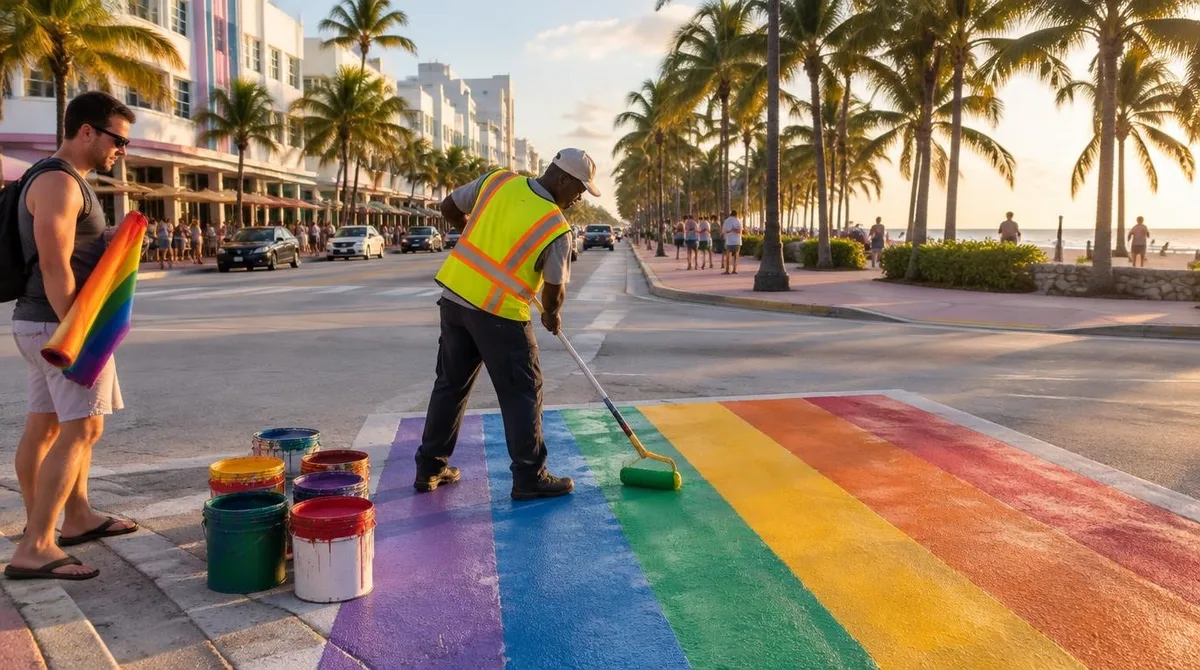
Ocean Drive and 12th Street held one of the South's most photographed symbols of queer visibility: the rainbow crosswalk Miami Beach installed in 2018. The state tore it out in October 2025. The city answered with a rebuild in Lummus Park, pavers and all.
That fight is part of a longer story about what a street can mean. Our piece on the Stonewall legacy in Miami traces how national history lands at home. The crosswalk belongs to that lineage.
Here is how paint became civic identity, and how it came back. It sits at the heart of our Pride coverage, and it says a lot about this city.
Where The Idea Came From
Rainbow crossings go back further than most people think. Wikipedia's history credits Taipei with the first one in 2008. West Hollywood installed the world's first permanent crossing in June 2012. It ran along Santa Monica Boulevard, right on the LA Pride route. Sydney followed in 2013, and when that city pulled its temporary crossing, residents fought back with chalk. They redrew the rainbow until the city gave in.
The idea spread fast after that. Cities now treat the crossings as permanent fixtures, especially in gay districts. The paint signals something plain: you are welcome on this block. The crossings also draw vandalism, which is its own kind of proof.
How Miami Beach Made It Permanent
Miami Beach went with terrazzo. The design firm Savino & Miller drew the pattern from the city's Art Deco District, and construction wrapped in 2018. Per Florida Politics (web.archive.org snapshot), the crosswalk was a tribute to Leonard Horowitz, the designer who gave the district its pastel palette. It sat at Ocean Drive and 12th Street, across from Lummus Park and the beach.
It became a landmark of the Art Deco District in its own right, per the report. A symbol like that does quiet work. Every crossing is a small promise about who belongs here.
The Fight With The State
Florida's transportation department notified Miami Beach in August 2025 that the crosswalk had to go. The order targeted roadway markings tied to social or political messaging across the state. Communities that refused risked losing state transportation money. The city appealed and lost in October. Crews removed the pavers amid protests that same month.
The fight was never about safety. It was about whether a city may keep a symbol its people chose. Miami Beach decided to test that answer.
What Stood Back Up
Commissioner Tanya Katzoff Bhatt sponsored a resolution to bring the symbol back, this time inside Lummus Park. Commissioner Monica Matteo-Salinas co-sponsored it. The commission set aside up to $120,000 from the city's 2025 year-end surplus, per Florida Politics. The plan reused pavers salvaged from the original site.
On April 10, 2026, during Miami Beach Pride, officials unveiled the result. It is a rainbow-colored pedestrian area that is, technically, not a crosswalk at all. Commissioner Alex Fernandez described the spirit of it: "we're going to collect these piece by piece and make out of them a mosaic of love." Bhatt pointed to the ground itself. "These pavers are the original pavers," she said, per the station.
The chamber's own director spoke too. "We are resilient, and no matter what, a crosswalk is not going to erase who we are," Lisette Garcia, the chamber's director, told CBS Miami.
Conclusion: More Than Paint
The lesson is not complicated. A symbol can be removed from a road, but not from a city that keeps voting for it. Miami Beach spent real money and real political capital to put its rainbow back on the ground, steps from where it started. The form changed. The welcome did not. On this island, that is the story. We covered a connected angle in How Miami Fought Back in 1977 and Changed LGBTQ+ History.