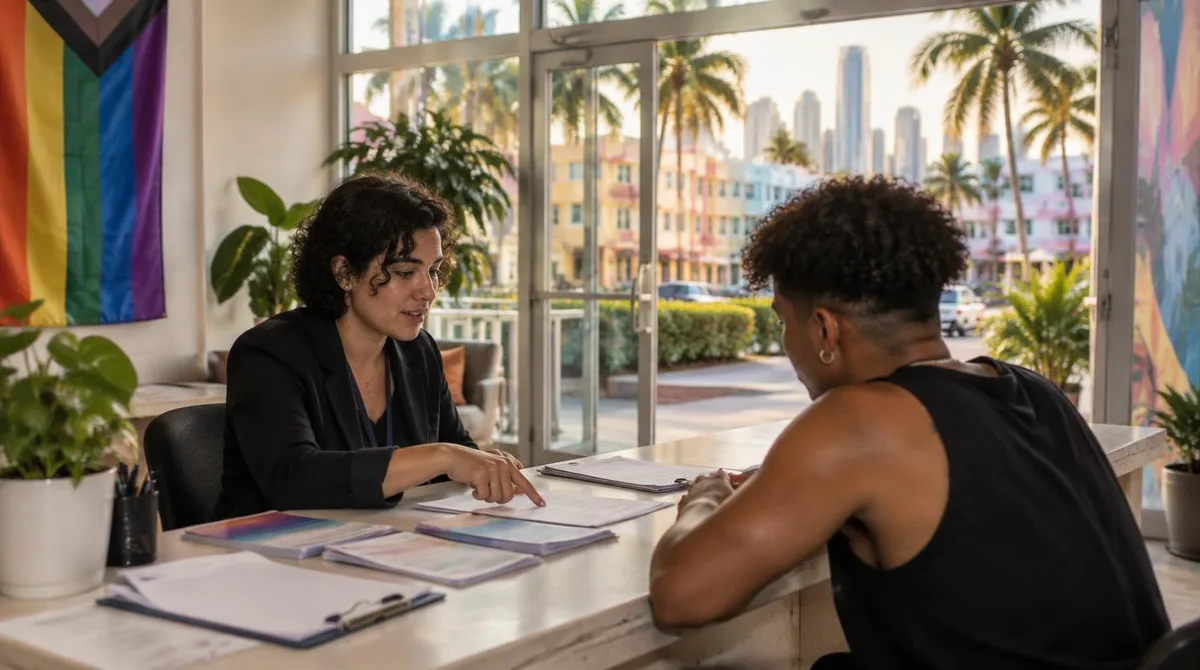
Walk into any community center in Miami-Dade and the same questions surface, whatever the month. Can my landlord do that? What happens at work if I come out? Does my relationship count on paper? The honest answer for Florida is that LGBTQ+ legal rights here are a patchwork: some protections are firm, some depend on where you live, and some have been contested in recent years. Knowing which is which is the first step.
This guide walks through the main areas people ask about — work, housing, family life, and safety — and explains the general landscape in plain language. It is information, not legal advice. Laws change, court rulings can shift a rule overnight, and a specific situation often turns on details no article can weigh. For anything consequential, a qualified attorney or a legal aid organization is the right stop.
One thing worth saying up front: Miami-Dade sits inside a state whose rules and a county whose rules do not always match. Local ordinances can extend protections the state does not provide. That layered structure explains a lot of the confusion, and it runs through every topic below.
Why does the legal picture feel so complicated in Florida?
Because three layers of law stack on top of each other, and they do not always agree. Federal law sets a floor in some areas. State law can add to it or, in places, pull in a different direction. County and city ordinances — Miami-Dade among them — can go further still. A person's protections can depend partly on which side of a county line they live on.
Court rulings add another moving part. A single decision can confirm a right, narrow one, or send a question back to lawmakers. That is why an answer that was accurate last year may need checking today, and why advocacy groups and legal organizations spend real effort keeping their guidance current.
Our analysis: treat any single-sentence answer to "what are my rights in Florida?" with suspicion. The better question is "in what area, at which level of government, and as of when?"
What protections exist at work?
The general picture: federal law has been read to bar employers from firing or mistreating workers because of sexual orientation or gender identity, and that baseline applies across Florida. Many larger employers add their own written policies that go beyond the legal minimum, because it is cheaper to keep a good worker than to replace one.
What the law generally does not hand anyone is a guarantee of comfort. Disagreements over dress codes, restrooms, and pronouns in the workplace remain active areas of dispute around the country, and outcomes can turn on the specific facts. Documentation matters here — keeping records of what was said, when, and by whom is a habit that helps no matter how a dispute resolves.
Public-sector jobs, private employers, and small businesses are not treated identically under every rule, which is one more reason the specifics matter. A worker who believes they have been discriminated against typically has formal complaint routes through government agencies, but those routes come with deadlines. Missing one can close the door, which is why acting early beats acting perfectly.
Where do housing and public accommodations stand?
Housing follows the same layered pattern. Federal fair-housing law covers some grounds; state and local law cover others. In Miami-Dade, local human-rights ordinances have long addressed discrimination in housing and public accommodations more broadly than the state does, and those local rules are often the most useful tool a resident has.
Public accommodations — the shops, clinics, hotels, and services people use every day — are the area where the gap between jurisdictions shows most clearly. What a business may refuse, and on what grounds, differs depending on the level of government whose rule applies. A practical habit: if an interaction at a business feels like discrimination, writing down the date, the address, and what happened turns a vague grievance into something an advocate or agency can actually work with.
For renters, the ordinary mechanics of Florida tenancy apply regardless of who you are: leases are contracts, evictions follow a process, and retaliation for asserting rights raises its own problems. Community organizations in South Florida can often help a tenant understand which layer of protection fits their situation before things escalate. Readers following this should also see The Volunteers Who Run Pride: Inside South Florida's Festival Economy.
What should families know about relationship recognition and family law?
Marriage between same-sex couples is recognized, and with it come the standard legal consequences — the ones that matter most in hard moments: hospital visitation, medical decisions, inheritance, and parental presumptions. Couples who want extra documentation, for travel or for peace of mind, often put powers of attorney and similar papers in place; Miami-Dade also offers a domestic-partnership registry for residents who want formal local recognition.
Parenting questions are where family law gets most technical. Adoption, second-parent adoptions, and the paperwork that follows birth all carry requirements worth confirming with a professional rather than assuming. The cost of getting the paperwork wrong lands on the family, usually at the worst possible time, so this is an area where a consultation early beats a crisis later.
What remains unsettled or contested in Florida — particularly around care for transgender youth and classroom rules — changes often enough that families are better served by current guidance from advocacy organizations than by any static article. Our sibling coverage of the state classroom-law settlement and how it lands for Miami families is one place to start for that specific fight. We covered a connected angle in Florida Classroom Law Settlement: What It Means for Miami Families.
What about safety, hate crimes, and reporting?
Florida has a hate-crimes statute that can enhance penalties when a crime is motivated by a victim's actual or perceived sexual orientation or gender identity, alongside other protected characteristics. But an enhanced penalty only matters if the incident is reported and correctly recorded. Underreporting — by victims who distrust the process and by agencies that classify incidents loosely — is a known weakness nationwide.
If someone experiences or witnesses a bias-motivated incident, the practical sequence is straightforward in principle: get to safety, get medical help if needed, document everything, and report. Community organizations can help a person navigate the reporting process, and some act as intermediaries for people who are not ready to deal with a station house directly.
Practical steps: what to do when a legal question comes up
Most legal problems get worse when they are handled alone and late. A few habits serve the community well, whatever the issue:
- Write things down. Dates, names, exact words. Contemporaneous notes carry weight that memory does not.
- Keep copies. Leases, employment records, medical and family paperwork. Store them somewhere safe and reachable.
- Check the date on any advice. A blog post from five years ago may describe a law that has since moved. When a source does not say when its guidance was last reviewed, treat it as a starting point, not an answer.
- Use the free resources first. Legal aid organizations, bar association referral services, and community groups can often sort a question quickly and at no cost.
- Know the deadlines exist. Complaint routes and courts run on clocks. Early action preserves options that delay destroys.
None of this replaces a lawyer. All of it makes the eventual conversation with one shorter, cheaper, and more useful.
Where this leaves us
The evidence points to a landscape that is neither as bleak nor as settled as the loudest voices on either side claim. Firm federal baselines exist in employment and marriage. Local protections in Miami-Dade fill real gaps. And a set of contested areas — schools, healthcare for young people, the fine print of accommodations — keeps the community's lawyers and advocates busy. What remains unknown at any given moment is which contested area moves next, and in which direction. The durable advantage belongs to residents who document, ask early, and get current guidance before acting.