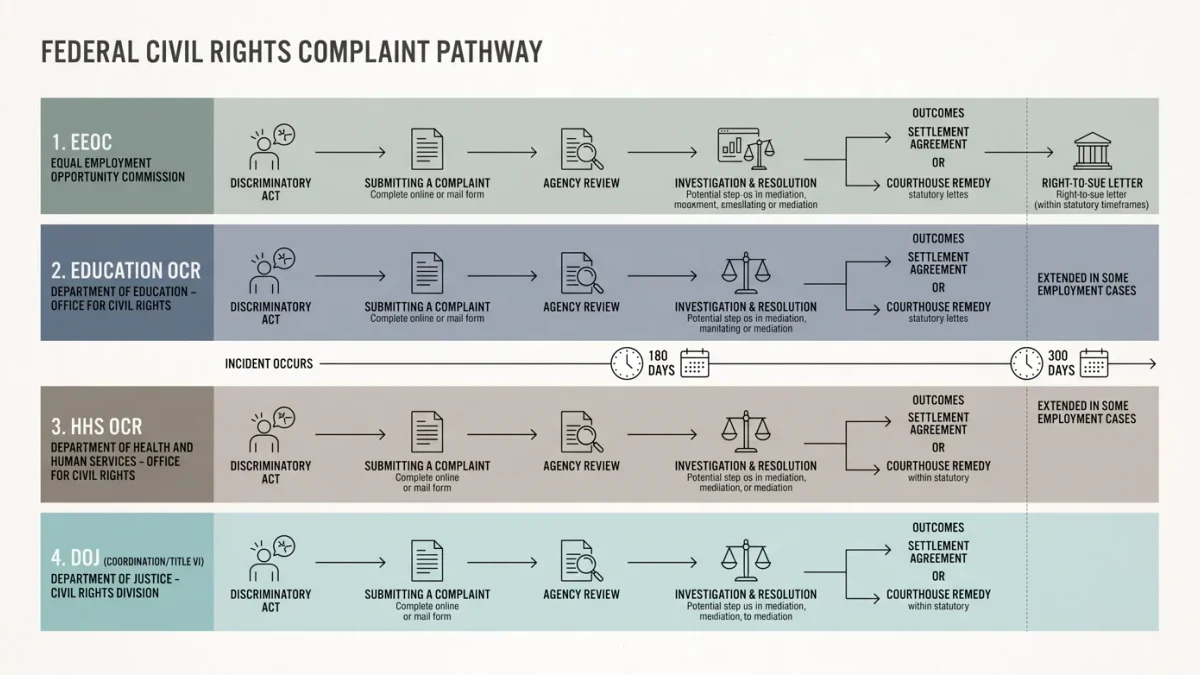
Visitors and newcomers often assume nondiscrimination protection is national law. It is not: federal civil rights statutes do not broadly cover sexual orientation and gender identity outside specific contexts, and Florida has passed no statewide LGBTQ+ nondiscrimination law. What protects residents and visitors here is a stack of local ordinances — county and city human rights laws built over five decades, with Miami-Dade holding one of the deepest histories in the American South.
This article publishes information about the legal landscape, not legal advice; for specific situations, consult qualified counsel or the agencies described.
What does the county ordinance cover?
Per Miami-Dade County's published ordinance structure, its human rights law prohibits discrimination in employment, housing, public accommodations, credit, and finance — with sexual orientation added by ordinance in the 1990s and gender identity in subsequent amendments, per the county's legislative record. The 1990s addition carried particular history: Miami-Dade's original 1977 ordinance including sexual orientation was repealed that year in the Anita Bryant-led campaign, and the protections were restored two decades later — a twenty-year arc that makes the county's current law a restoration, not a first draft.
How do the cities layer on top?
Municipal ordinances extend and duplicate. Miami Beach adopted its own human rights ordinance — historically among the state's strongest, per its published municipal code — covering the same domains with local enforcement, and other municipalities across the county maintain their own versions. The practical meaning of layering: a complaint can have multiple potential routes, and cities without their own ordinances default to the county's. Per municipal records across the region, the map is dense in Miami-Dade compared to much of Florida, which is part of what defines the region politically.
How is the ordinance actually enforced?
Through complaint-driven process. Per the county's published procedures, the human rights machinery includes an investigative agency that receives complaints, investigates, and can pursue remedies through conciliation and, where established, through hearing processes; deadlines apply — complaints must be filed within defined windows from the alleged act. The practical guidance the agencies publish: document what happened, file promptly, and use the intake process — which exists precisely to route complaints that no lawyer has yet reviewed.
Why does the state gap matter?
Because local protection is local only. A resident's protections end at municipal and county lines in domains the state has not covered — and preemption, the state Legislature's practice of overriding local regulation, has been an active threat to local ordinances in recent sessions, per legislative tracking across recent years. Advocacy organizations have run state-level nondiscrimination campaigns for years without legislative passage, per their public records. The result is the current structure: a strong local stack standing in for an absent state floor, defended locally each session.
What should a resident actually know from all this?
Three things. First, protection here is real but locally built — and knowing which ordinance covers which situation matters when something happens. Second, the processes have deadlines; prompt filing is the difference between a viable complaint and a closed door. Third, the stack is political: each layer was won locally, survives by local politics, and is worth defending at the county commission and city commission levels where it actually lives. The ordinances are the community's settled law — and its ongoing project.