Clothes spoke when speech was dangerous. A bandana folded into the right back pocket, a ring of keys hung on one hip: each detail carried a message the wearer chose, at a time when saying it out loud could cost a job, an apartment or worse.
Style worked like a language, and like language it kept changing. Our primer on LGBTQ terms, explained respectfully reads the vocabulary; this one reads the wardrobe, from the pocket codes of the 1970s to the museum galleries of today.
The short version: when visibility meant danger, fashion carried hidden signals. After Stonewall, the same wardrobe walked in daylight. In 2013, a New York museum put a century of it behind glass. Here is how that happened, one detail at a time, as part of the wider story our culture coverage follows.
When a Pocket Was a Language
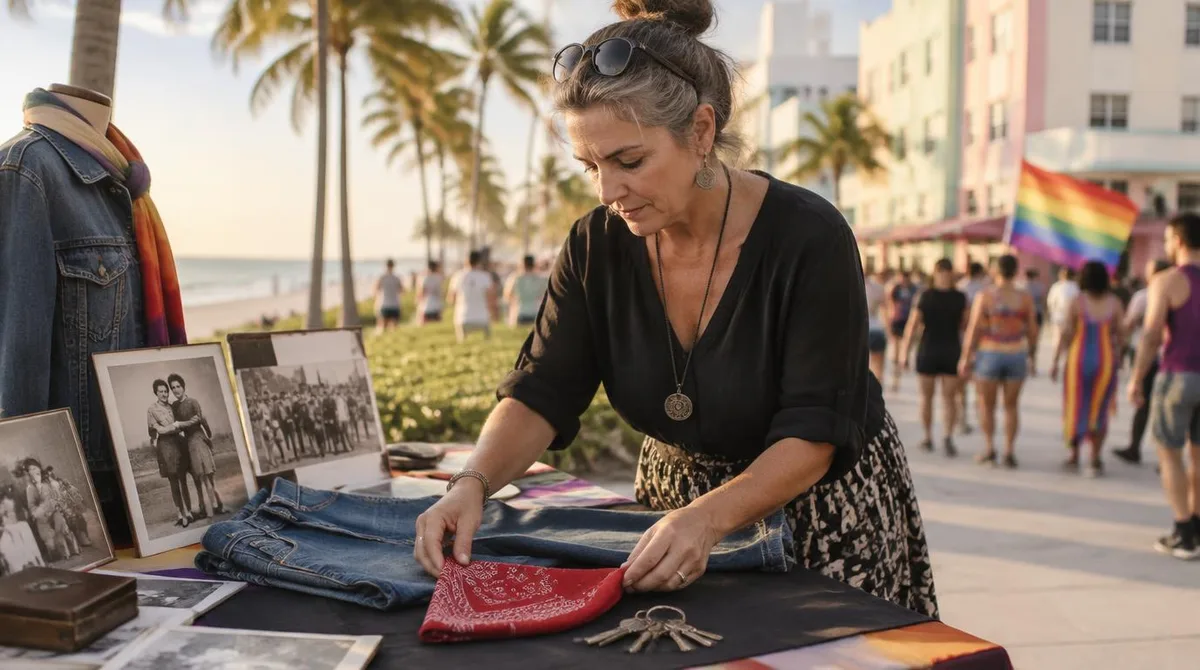
The clearest code was the handkerchief code, also called flagging. A colored bandana worn in one back pocket signaled a preferred role, and the color filled in the rest. The system peaked in the 1970s across the United States, Canada, Australia and Europe, and it grew out of something smaller: keys.
Wearing keys on one side of the body or the other was already a common signal among gay men. The best-known origin story points to New York City around 1970, where a Village Voice journalist joked that colored handkerchiefs would do the job even better. Some histories push further back, to Gold Rush-era San Francisco, where men in square dances wore blue or red bandanas to split the dancing parts.
The Castro Look Said It Out Loud
By the late 1970s, San Francisco's Castro district dressed the part of a community that had stopped whispering. The Castro clone look ran on working-class pieces: shrink-to-fit Levi's 501s, plaid shirts, tight T-shirts, boots, and often a full moustache. The style modeled itself on the greasers of the 1950s and 1960s.
The earliest recorded use came from writer Arthur Evans, who wielded the term as a jab in poster broadsides he pasted around the neighborhood. The mock target became a uniform anyway. Gay men adopted the attire so often, at first while bar-hopping, that it soon became the signature of the post-Stonewall generation on those blocks.
Street Style Walks Into a Museum
In 2013, a landmark museum survey of LGBTQ fashion history opened in New York. The Museum at FIT staged A Queer History of Fashion: From the Closet to the Catwalk, curated by Fred Dennis and Valerie Steele, with roughly 100 ensembles spanning more than a century.
The show put subcultural style at the center of fashion history: drag, leather and uniforms hung beside explorations of androgyny and dandyism. The project's book, published by Yale University Press, won the Costume Society of America's 2014 Millia Davenport Publication Award, and the museum counted three awards for the exhibition, the website and the publication combined. This connects to our earlier piece, Inside Pridelines, the Center That's Anchored Miami's LGBTQ+ Community Since 1982.
Why the Old Codes Still Matter
A code is only needed when the truth is unsafe. That is the quiet logic underneath it all: bandanas, keys, a moustache worn like a flag. Reading those signals today takes effort, and the effort teaches you what silence cost and how much style could say inside it.
The exhibition's curators traced the influence directly, placing subcultural and street styles at the heart of modern fashion. What a community wore to survive became source material for runways and retail racks, one borrowed silhouette at a time.
Conclusion: The Wardrobe Still Talks
From a folded bandana to a museum gallery, this history is the record of a community learning to be seen. The codes softened as the danger faded, but the instinct to speak through style never left.
You can read it on any pride weekend in Miami, and on any ordinary Tuesday too: an outfit chosen on purpose, in colors that once had to whisper.