Pride season moves money through Miami in a specific, traceable way: room nights in South Beach, stage builds at Lummus Park, booth fees, bar tabs, and grants that keep nonprofit doors open. Miami Beach Pride, the group behind the biggest weekend, says its annual budget tops $1.2 million, and that most of its programming stays free to walk into.
Who steers that money matters as much as the total. Our profile of the openly LGBTQ officials in South Florida government covers the people side of the ledger. The dollar side starts each spring on Ocean Drive.
Here is where pride cash actually lands, event by event, with the numbers that exist and the ones nobody publishes. We track stories like this year round on our local news desk.
Miami Beach Pride Is the Engine
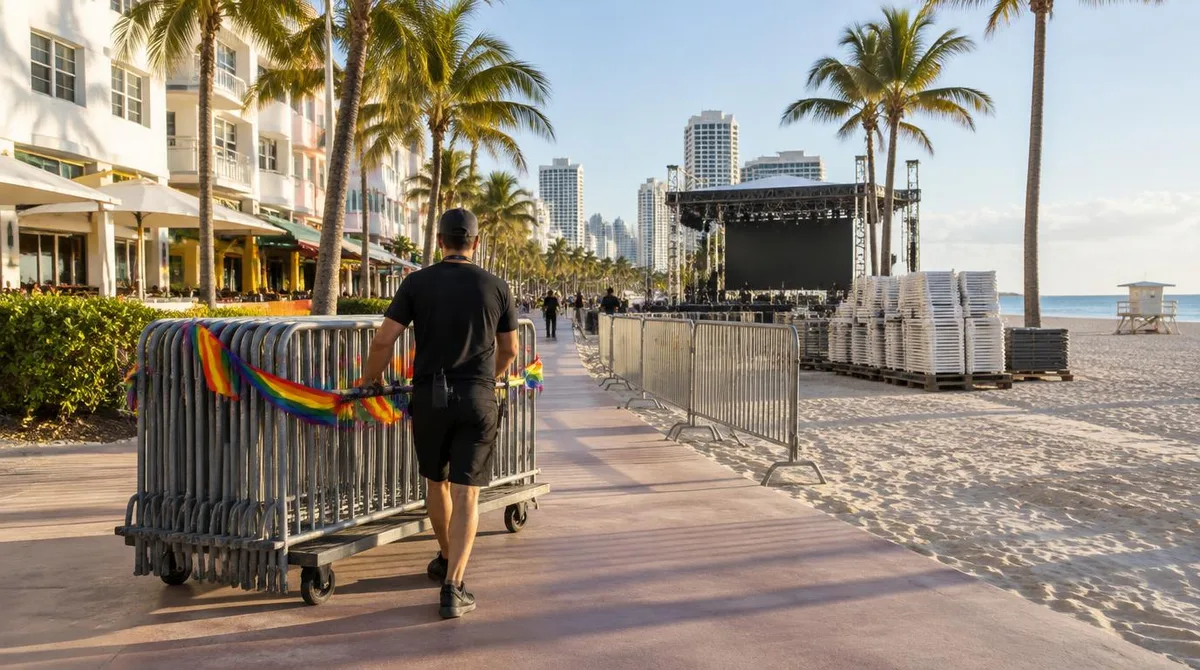
Miami Beach Pride started in 2009 as what its chairman, Bruce Horwich, calls a modest parade. It now fills a 10-day calendar. For 2026, the organization booked April 2 through April 12, with the festival and parade weekend set for April 11 and 12 at Lummus Park and Ocean Drive.
The scale has climbed for years. Per Wikipedia's account of the event, more than 80,000 people took part in 2013, and the 10th anniversary festival drew 130,000 attendees in 2018. For its 18th year, the organization says it expects more than 170,000 attendees, and its own description of the event cites a regular draw of 185,000 or more.
The phrase "pride month Miami" usually evokes June. The ledger says April, when this festival pays out.
How the Money Actually Moves
The weekend works like a temporary marketplace. Per the organizers, the two-day festival at Lummus Park carries two stages, sponsor activations, curated pavilions, a food village, and hundreds of exhibitors representing nonprofits, community groups, and businesses. The parade then runs up Ocean Drive from 5th Street to 14th Street on Sunday at noon. We covered a connected angle in Who Owns the Street? How Festival Permits and Road Closures Actually Work.
Public money sits inside the budget too. Miami Beach Gay Pride, Inc., the nonprofit behind the event, is sponsored in part by the City of Miami Beach and supported by the Miami-Dade County cultural affairs apparatus, according to the group's own release. Hotels join the flow as well, hosting pride events and listing themselves as official travel partners.
What the Numbers Say, and What They Do Not
The hard numbers on the table are organizer figures: a budget above $1.2 million, attendance in the six figures. Treat them as estimates from the people who run the show. Free events have no ticket counts, and no city or county agency publishes a pride-specific economic impact report for Miami.
That gap is worth naming. Hotel tax collections and sales receipts exist inside government files, but no official study breaks out what pride weekend adds. The honest math rests on attendance estimates and the organizers' own budget line.
Beyond One Weekend on the Beach
Pride spending spreads across the county, and across the calendar. Gay8, the festival in Little Havana, has drawn more than 60,000 attendees a year since its start in 2015, per Wikipedia, and bills itself as the largest Hispanic LGBTQ festival in the country. The Miami-Dade Gay and Lesbian Chamber of Commerce opened an LGBTQ visitor center inside Old City Hall on Miami Beach back in 2010.
Smaller events fill the rest of the map: film festivals, pageants at Palace, mixers on Lincoln Road. Each one rents, staffs, pours, and pays.
Conclusion: The Ledger Runs All Year
Pride season is the peak, not the whole story. The checkbook behind Miami's LGBTQ economy stays open in every month: the chamber's visitor center, a Little Havana street party, a theater seat in April or October.
The numbers worth trusting are modest and sourced: $1.2 million to run one festival, six-figure crowds on Ocean Drive, 60,000 more in Little Havana. What those figures buy is a year-round circuit of work for vendors, venues, and nonprofits that call these neighborhoods home.