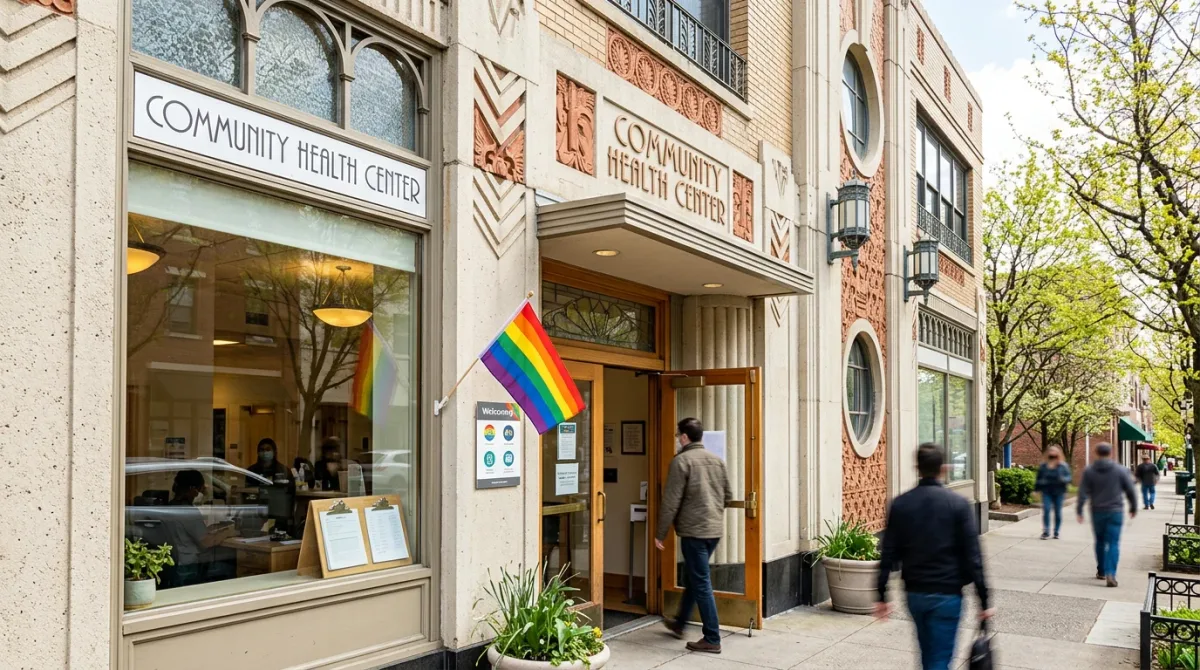
Miami-Dade’s LGBTQ+ community can reach free HIV and STI testing, PrEP and PEP navigation, and mental health support through two main channels: the Florida Department of Health in Miami-Dade County’s testing and prevention program, and Pridelines, the Miami Beach community center that has served the county since 1982 (SRC-04). Both are free or sliding-scale, and neither requires proof of insurance to walk in the door.
None of this is new territory for Miami-Dade. The county has run organized HIV prevention and testing programs for decades, and the LGBTQ+ community — particularly gay and bisexual men — remains a primary focus of that outreach nationally, per the Centers for Disease Control and Prevention (SRC-03). What’s changed is how many doors now lead to the same care: a county health department, a community center, and a mobile testing van all point back to the same core services.
Where do I get free HIV or STI testing in Miami-Dade?
The Florida Department of Health in Miami-Dade County offers free, confidential HIV rapid testing through its Take Control initiative, delivered in non-clinical community settings rather than a traditional clinic waiting room (SRC-01). The department’s Test Miami program runs a mobile testing unit that screens for HIV, chlamydia, gonorrhea, and syphilis at locations across the county, and also ships free at-home OraQuick HIV test kits on request (SRC-02). One fixed Test Miami site operates Wednesdays only at 2515 West Flagler Street, 1st Floor, Miami (SRC-05). For county testing questions, the counseling and testing line is 786-792-5269, or email test.miami@flhealth.gov (SRC-02).
Pridelines, at 1130 Washington Ave in Miami Beach, also provides HIV testing and STI screening on-site as part of its health and wellness programming, alongside primary care access through pharmacy partnerships (SRC-04). Reaching the center directly — 305-571-9601 — is often the fastest way to ask what’s available that week, since community organizations can adjust hours around events and outreach schedules.
How do I get PrEP or PEP in Miami-Dade?
PrEP, or pre-exposure prophylaxis, is a daily medication that the CDC says greatly reduces the chance of getting HIV from sex or injection drug use for people who are HIV-negative (SRC-03). The agency recommends it for people who’ve had anal or vaginal sex in the past six months with an HIV-positive partner, inconsistent condom use, or a recent STI diagnosis, and for people who inject drugs and share equipment or have HIV-positive injection partners (SRC-03). Protection builds over time with daily use — about seven days for receptive anal sex and about 21 days for receptive vaginal sex or injection drug use, per CDC guidance (SRC-03).
PEP, or post-exposure prophylaxis, is the emergency version: a 28-day medication course that has to start within 72 hours of a potential exposure (SRC-01). The county health department’s HIV prevention program also runs a PrEP/nPEP workgroup focused on building better local access to both medications and stronger relationships with prescribing providers (SRC-02). Pridelines separately offers direct navigation for PrEP, PEP, and DoxyPEP — help figuring out coverage, providers, and paperwork rather than a prescription itself (SRC-04).
What else does Pridelines offer beyond testing?
Pridelines describes its approach as an integrated care model addressing physical, mental, spiritual, and social wellness, and the health programming sits alongside a broad set of community services (SRC-04). There’s youth programming for ages 13 to 24, including a leadership track called Hero Academy and sexual health education. For adults, the center runs sliding-scale therapy and mental health services, a bilingual support program for Latine men called Hermanos del Sol, a cultural gathering space called the Lavender Lounge, and HALO programming for adults 55 and older. The center also runs mobile outreach into suburban parts of Miami-Dade that sit farther from its Miami Beach location (SRC-04).
These aren’t advertised as add-ons to the health work — Pridelines frames the whole model as connected, on the theory that a resident is more likely to keep a testing appointment or stay on PrEP if the same building can also help with a therapist referral or a support group. It’s worth noting that Pridelines’ own account of its programming is organizational self-description, not independently audited, though its testing and prevention services align with the county’s public health framework (SRC-01, SRC-04).
What other prevention and outreach programs exist?
Beyond one-on-one testing appointments, the county health department runs HIV and STI prevention workshops for organizations and staff, community outreach at health fairs and public events, and a speakers bureau that features people living with HIV sharing their experience directly (SRC-02). The department also offers behavioral intervention sessions tailored to specific groups, including sessions designed for men, as part of its broader HIV/AIDS services (SRC-01). None of this requires a referral — organizations and individuals can request a session or event visit through the department directly.
Pridelines folds similar outreach into its mobile programming, carrying testing and navigation services into suburban parts of Miami-Dade that sit farther from its Miami Beach storefront, on the premise that a center should meet people where they already are rather than waiting for them to travel (SRC-04). Between the county’s clinical infrastructure and a community center built specifically around LGBTQ+ life, Miami-Dade residents have more than one entry point into the same basic set of services — testing, prevention medication, and a place to ask questions without having to explain who they are first.
Do I need insurance to use these services?
No. Miami-Dade’s county-run testing through the Florida Department of Health is free and confidential by design, aimed at reaching people regardless of insurance status (SRC-01, SRC-02). Pridelines’ therapy and counseling programs are offered sliding-scale, meaning the fee adjusts to what a client can pay (SRC-04). Anyone unsure what a specific visit will cost should call ahead — 786-792-5269 for county testing, 305-571-9601 for Pridelines — since programs and funding can shift year to year.
For a related pride perspective, read Miami-Dade's LGBTQ+ Health Resources, From HIV Testing to Youth Support.